

Supreme Court Implicates IEBC in Detailed Judgement on the Invalidation of President Uhuru's Win
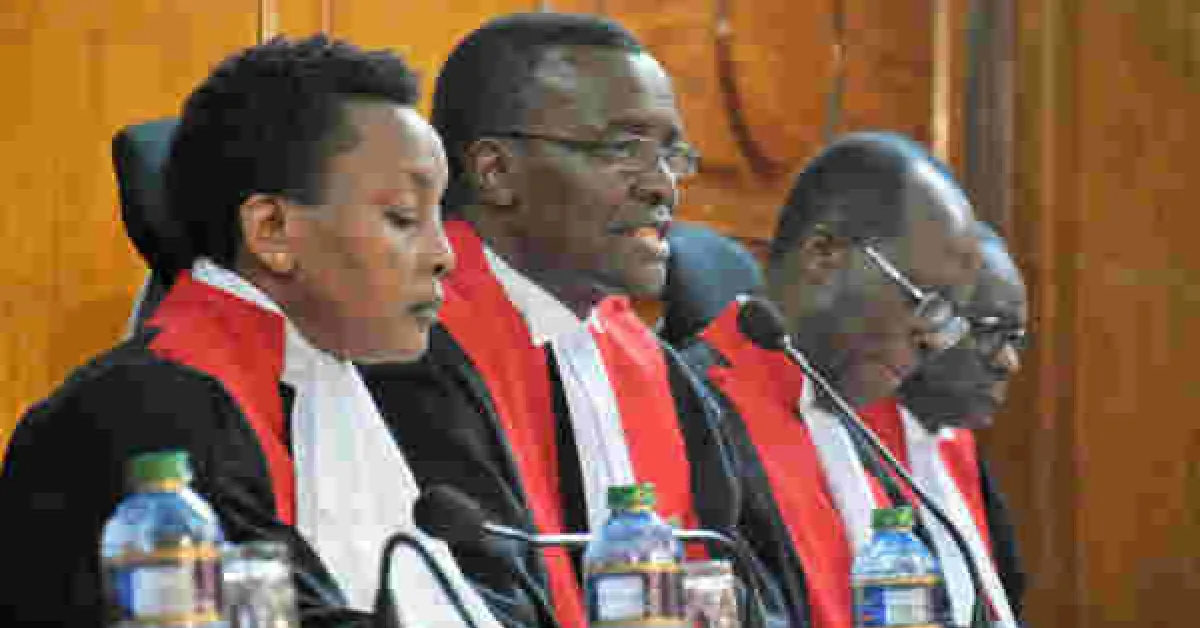
The Supreme Court has delivered its full ruling on the invalidation of the August 8th presidential election.
Reading the judgement of the majority, the Supreme Court highlighted some of the key reasons they overturned the poll.
The judges ruled that IEBC defied the order to open its servers for audit, saying this could have helped the commission disapprove Nasa’s claims that its servers were hacked. It was the view of the majority judges that electoral commission chairman Wafula Chebukati failed to explain why presidential election results were not transmitted in the prescribed manner. It also ruled that it was the mandate of the commission to ensure that the system of voting, counting and tallying of results is verifiable and accurate.
The majority further found that Nasa proved that IEBC announced the presidential winner before receiving all 40,883 Forms 34As and thus used forms with dubious authenticity.
The court also found no evidence that President Uhuru Kenyatta used the release funds IDPs as a campaign tool to entice voters.
The Judges, therefore, said that IEBC must henceforth hold subsequent elections in conformity to the law.
They further note that a random scrutiny of 4,299 Forms 34As indicated there were widespread discrepancies.
"The Independent Electoral and Boundaries Commission (IEBC) flouted the law and the constitution to the extent that they become the law themselves.
On our part, elections is not just an event but a whole process, this is also described in IEBCs handbook," DCJ Mwilu Said. She added: "IEBC did not verify results that had been electronically and systematically transmitted from the polling stations before announcing which violated the Constitution and the law,".
"IEBC CEO Ezra Chiloba admitted that IEBC was not in a position to supply the petitioner with all Form 34As, three days after results were announced and insisted presidential election was based on Form 34B which were all submitted. This raised questions. Apart from duty to verify, IEBC has duty to ensure the system of voting should be simple, accurate, accountable and secure. Numbers must just add up. Kenyans endured long hours and cast vote then after that the system became opaque. We can't prove that Uhuru Kenyatta got majority votes," Mwilu noted.
Reading the majority judgement, Deputy Chief Justice Philomena Mwilu stated that the refusal of the IEBC to give access to servers meant that Opposition was right about hacking claims. "The system was compromised and contaminated or the IEBC interfered with the data and refused to accept that it had bungled the system," she said. "Our order of scrutiny was a golden opportunity for IEBC to discredit the petitioner's claims but they disobeyed the court order."
She also said the that IEBC "contemptuously disobeyed" the court order which she noted was "critical". "IEBC should have had backups. We gave the petitioner a read-only access but there was clear reluctance on the IEBC's part that they did not want to give the information."
"(From a random sample) out 291 forms, 56 had no watermarks features while 31 did not bear serial numbers and a further 5 were not signed at all and 2 were only stamped by returning officers but not signed, in addition a further 32 forms were not signed by agents. The above indices put accountability of forms in question. The results of August 8 election cannot pass the test of authenticity and we have to nullify them despite the numbers," Chief Justice David Maraga said while reading the majority ruling.
Chief Justice David Maraga agreed with Deputy Chief Justice Philomena Mwilu, Smokin Wanjala and Isaac Lenaola that the election was not conducted in accordance with the dictates of the constitution and absolved President Uhuru Kenyatta from any blame in the judgement delivered on September 1st.
They ordered IEBC to conduct a fresh election within 60 days from the day the ruling was delivered.
Justices Jackton Ojwang’ and Njoki Ndung’u, however, dissented, stating that the petitioner, failed to prove allegations that the polls were rigged in favour of President Kenyatta. The two ruled that the polls were free, fair and credible as described by international observers.














Comments
Now for a Doctor to cure his…
Permalink
Now for a Doctor to cure his/her patient, proper diagnosis must be done. Now that the Supreme Court has identified the culprits of the Aug. 8th bungled election, it has become clear that the patient had cancer and the tumor growing this cancer is and was the current IEBC and the sugar feeding this tumor is and was jubilee operatives. Therefore to cure this patient i.e To do an election without RIGGING, we must have fresh IEBC officers and arrest the current officers together with their jubilee masters, charge them and prosecute them to the full extend of the law. Short of these measures Kenya will suffer Irrepairrable damage which might lead to civil war na kadhalike.This patient is in ACUTE stage in its disease progression. HELP
The judges have spoken. The…
Permalink
The judges have spoken. The issue was IEBC and not the numbers. Why then did the court not order manual recount? The physical votes are available up to 6 months. Second, Raila was categorical that courts were not an option for him to contest the results. Who promised Raila and the NASA team a win in court, that being the reason for the U-turn? Mwilu and Lenaola have been widely mentioned as having meddled with the courts in favor of NASA. If proven, they must be removed. “Mwilu stated that the refusal of the IEBC to give access to servers meant that Opposition was right about hacking claims”. Mwilu’s assertion was total legal reasoning nonsense that was not supported by facts. Judgements must be based on verifiable evidence and not on presupposed innuendos. Third, Raila and NASA engineered the ejection of former IEBC staff who had the experience and knowledge to conduct flawless elections. Was this a plan because NASA knew the new team could not gain relevant knowledge in 7 months in order to conduct smooth elections. Something smells.
Sonora. Being a Kikuyu born…
Permalink
In reply to The judges have spoken. The… by sokora (not verified)
Sonora. Being a Kikuyu born and raised Metropolitan, I am ashamed of you. You do NOT represent Our People very well. You are TOO tribal and 99% of the ythings d0 NOT make sense at all.
He is not trying to make…
Permalink
In reply to Sonora. Being a Kikuyu born… by Guest1 (not verified)
He is not trying to make sense to you because you don't understand sense at all. All you can understand is nonsense.
Maraga. What the SCoK is…
Permalink
In reply to He is not trying to make… by Maraga (not verified)
Maraga. What the SCoK is done. No more Irrelevant Excuses. The Red Sea has Drowned the MISIRIans. Done.
@Guest1: It is okay for you…
Permalink
In reply to Sonora. Being a Kikuyu born… by Guest1 (not verified)
@Guest1: It is okay for you to be a Kikuyu; however, opinions should not be aligned to our various communities. If I say you look like a runner, that does not make you a runner. What is your real name? Njambi? Heeh, just wondering. You are good.
Mwilu and Lenaola must first…
Permalink
Mwilu and Lenaola must first clear their names before they give any judgment.They must tell Kenyans how they shared the PAY BILL and Wanjigi billions paid by muuaji Raila to overturn the choice of 8.2m.Kenyans.A KANGAROO COURT OF SHAME.There is no difference between that useles court and traffic policemen on Waiyaki way,weight bridges or Nairobi County askali chasing a hawker for a bribe.MAKASHIA
Face the facts and quit…
Permalink
In reply to Mwilu and Lenaola must first… by Omera (not verified)
Face the facts and quit rationalizing like a schizophrenic suffering from hallucinations and delusions. Where do you get your facts from? I support Uhuru, but that alone doesn't mean i ignore presented facts! IEBC messed up the entire Nation and they MUST be held accountable. They Supreme Court have served the Nation right, they are doing their job. Treat the cause, not the symptom.
Mwilu and Leneola judgements…
Permalink
In reply to Face the facts and quit… by Zep (not verified)
Mwilu and Leneola judgements are zero for the time being as far as justice is concerned.They are being accused of complicity with the petitioner which might also give birth to more judges being implicated.Ngonja ngano mbwana/mama,kula mahindi kwanza. Kumbuka-NCHI YA KITU KIDOGO/KIKUMBWA
Niwauga ma hau!! IEBC messed…
Permalink
In reply to Face the facts and quit… by Zep (not verified)
Niwauga ma hau!! IEBC messed up but most of us are blinded by tribal allegiances and ignorance. Maraga made a good case as to how they reached the ultimate decision and you cannot help but admire his dedication to making sure the process is constitutional and fair. Am a kiuk but I can care less, IEBC messed up and it is time we had fair and credible elections, kenya belongs to us all and not just 2 tribes.
@Ufisadi, totally agree! I…
Permalink
In reply to Niwauga ma hau!! IEBC messed… by ufisadi (not verified)
@Ufisadi, totally agree! I am a kyuk too but Kenya is larger than a single tribe. Some Kenyans are chronically too tribalist to the point where they are blinded to facts. It's regrettably disturbing. I applaud Maraga and his team for laying out the facts and refusing to conform to the Kenyan way of kitu kidogo. We will never be united as Kenyans if we are not fair and open minded.
I agree with most of your…
Permalink
I agree with most of your comments. I beg to ask how about the compromised justices that colluded with NASA? Their rulings to me added no legal weight? Maraga is yet to comment anything ?Such a coward he needs to address this sooner than later. While there were few clerical errors, it did not justify repeating the elections. In fact Maraga himself admitted all elections have few issues. The margin of error was great that NASA could only focus on IEBC technical issues. The plot was for Maraga to rule himself as the president. Uhuru was bright enough to swear in all his MPs within the first Parliament before this ruling which afforded him a house speaker . They had not seen that coming. NASA and Maraga did not attend this first parliament. NASA called for boycott yet some of its members went to sign in as present against the boycott of NASA leaders Raila and Wetangula. That was smart because thats their bread and butter and were not elected by NASA. Without swearing in MPs there would be no house speaker who in-fact in case of void, Speaker would become president. In case there is no speaker, Chief justice becomes interim president. This judicial coup was well planned from 2013. Please note the attack on petition was not on jubilee. The petition was filed solely against Uhuru. Ruto would have had a challenge defeating because Raila would have come up with his usual conspiracy theories that Ruto gamed UHURU. It was a thick plot. God works miracles and it was such an embarrasmment to listen to the ruling which in my context was favorable if we had justices that have colluded with NASA. such a disgrace for an office that someone has taken an oath of allegiance.
Collusion with NASA is mere…
Permalink
In reply to I agree with most of your… by John Mukono (not verified)
Collusion with NASA is mere allegations! Anybody can say anything in a smear campaign. Take the facts to Court and avoid being a victim of she said, he said. I urge every Kenyan who has credible information to present them to courts.
There is no tallying system…
Permalink
There is no tallying system without errors in any part of the world so don't give us that. What countries do is try and perfect them with time. As THE Supreme Court, you can not base a judgement that has the likelihood of destabilizing a country because IEBC refused to provide data. You subpoena them and prosecute for contempt. Fortunately we know now that even though some had the gall to read aloud a judgement on IEBC they can not hold a candle on honesty. Their judgement was fake, compromised and corrupted. They were busy meeting the opposition during all this time SO this judgement is riddled with taint and the best thing they can do for this country is swear in Uhuruto and let's move on. Another thing is what happens if IEBC makes a few more mistakes next time? Will we go back to the bucket again?? Can we afford this? When does this madness stop?
They had the power to either…
Permalink
In reply to There is no tallying system… by Ndikwenda wana (not verified)
They had the power to either just affirm the will of the people and accept that UhUru won.Or at the very minimum do a manual Recount to ascertain the will of the People.However they did not do this.Instead they came up with this ridiculous decision.Jubilee really needs to look at this accusations against MWilu and Lenaola.If there is factual basis supporting the accusations.Then these Judges need to be held accountable.And if the law provides that this judgement can be annulled, then so be it.We need reasonable heads to prevail.
You have a right to take…
Permalink
In reply to They had the power to either… by KIM (not verified)
You have a right to take them to court if you think there is a case. It's your right as a citizen of Kenya, anyone can file a case. It's legal and constitutional if you understand laws and principle laid down by the constitution.
you make a lot of sense!!…
Permalink
In reply to You have a right to take… by GG (not verified)
you make a lot of sense!! when these fools steal public money they dont only still from Western or Central, they steal from every kenyan but when they get in trouble they go back to their fanatical bases who can be easily manipulated and incited by fake news like the collaboration btwn the judges and nasa
Dada Sukari, uko wapi? Mbona…
Permalink
Dada Sukari, uko wapi? Mbona kanyamaza hivyo?
In other words we nullified…
Permalink
In other words we nullified the election FOR FUN. KSH 40 Billion down the drain because NASA was not allowed to peep into intellectual property, compromising patent.
@Honestly.That said.I…
Permalink
In reply to In other words we nullified… by Honestly (not verified)
@Honestly.That said.I personally think that it is important to keep repeating.That the Jubilee Party has the clear mandate of the People.The Jubilee Party is in control of the ship of state.And as such it carries the political leadership mantle of the country.Therefore the Jubilee Party should use its weight and influence to ensure that it continues to provide leadership and maintains the peace/stability and civil order in the country.Now more than ever.The Kenyan Public will in turn reward the party by voting for the Party with even greater majorities.When people look back at this period I hope that they will thank the Jubilee Party for having lead the country thru this period in a peaceful and stable manner.For the benefit of the entire Kenyan Population.
My fellow Kenyans, we must…
Permalink
My fellow Kenyans, we must make an effort to look for the best qualities in every one of us and bring them together for the future of our beloved and beautiful nation of Kenya.
As the late Dr. Martin Luther King Jr of Atlanta, Georgia shared with us his famous words of wisdom, " We must learn together as brothers and sisters or perish together as fools."
Correction: …
Permalink
Correction:
Dr. King said:
" We must learn to live together as brothers and sisters, or perish together as fools."
The end justifying the means…
Permalink
The end justifying the means in law? "DCJ stated that the refusal of the IEBC to give access to servers meant that Opposition was right about hacking claims" If NASA did not prove their case was why is IEBC obligated to build NASA's case. When did the absence of evidence became a basis to indict in law? It is not dualistic, IEBC may have failed to provide access but that does not necessarily imply the petitioner is right. Looks like everything was done at the bench; petition, prosecution, investigations and judgement. It has not been demonstrated what actual harm resulted from the transmission irregularities. As much as DCJ put it "We can't prove that Uhuru Kenyatta got majority votes" the petitioner and the SC did not disapprove that he got the majority vote-since no recount of votes cast was ordered. It looks like as electorate we have acquired a very complicated machinery that cannot perform the intended task partly because no one (that matters) reads the guide to understand its functions and limitations. And partly it is forced to do what it was not made or meant to do, thanks to our institutions elevated sense of perfection(not performance).
Even after the judges gave…
Permalink
Even after the judges gave the ruling some of this Jubilee sychophants refuse to accept the truth and insist they had the numbers. Really from what fake 34Aand 34B forms some of which were signed, forged and even missing. Blame the IEBC and leave NASA out of this watching the court proceedings your lawyers talked down and treated NASA like they were second class citizens.Your boss bold told NASA to go to court .You lost now insults threats démonstrations and impeachment is all we hear about.We shall meet at the élections you and your mighty numbers.
Okay IEBC messed up on their…
Permalink
Okay IEBC messed up on their part that we can agree on. Now, you can't accuse me of stealing your chicken and take me to court where the judge orders me to produce the feathers or the stew made of chicken and if i don't he finds me guilty of stealing your chicken
I wound like to hear…
Permalink
I wound like to hear opinions from other kenyan professional living in more democratic countries like Japan, Taiwan, Sweden,Norway, Denmark etc. Because we already know countries like U.S and England would not have ordered a new election b/c they are aware of both the cost(money) and also no one person is bigger than the country and its electorate, they would not have punished the people who already did there part and voted for their candidate.It made us wander where maraga and the other judges got their education and if its kenya, may be we should go back to our tribal courts. If it's IEBC which was not fourth coming with information maraga should have stayed on their neck untill they give him what he is asking,instead he just takes it easy and comes with this ruling punishing the electorate and all the money thus spent evaporate to dust, the other justices like milu, looks like she is in a fog of deep sleep. I feel all these 7 judges need to go without pay from now on b/c of this boogies ruling. Defensive strategies are allowed all over the world where the plaintiff will not offer inform easily, he should have played hard balls with Chebukati and Chiloba and put them in jail for contempt of court for refusing to supply information asked by court and they would have supplied the info. For those of us who deal with kenyan courts. The delivery of services and judgement are wanting.
The IEBC is simply the…
Permalink
The IEBC is simply the symptom of the disease that has permeated kenya political landscape since independence and bears its ugly manifestation in the name of jubilee, so this disease and therefore the issue is NOT the Justices but to eliminate this disease along with its symptoms. GET THE DRIFT?
Add new comment