
Planting for Justice: How Mathare Residents Turn Trees into Memorials
Residents of Mathare in Nairobi began planting trees in August 2017 to honour people killed during police operations, linking memorialisation with demands for environmental and social justice.
The effort was organised by the Mathare Green Movement (MGM), a community-led group that uses tree planting to address long-standing neglect in the settlement. For participants, trees serve both practical and symbolic purposes, marking sites of loss while improving an area with little access to green space.
Planting trees in Mathare presents serious challenges. The settlement is densely populated, built on unstable ground, and affected by pollution and poor waste management. Space is limited, and young trees often struggle to survive. Each planting therefore requires sustained care and collective effort.
Environmental activist Martin Oduor, a member of MGM, documented the scale of the problem through a tree census. He found that Mathare, with an estimated population of about 500,000 people living on less than three square kilometres, had roughly one tree for every 1,200 residents.
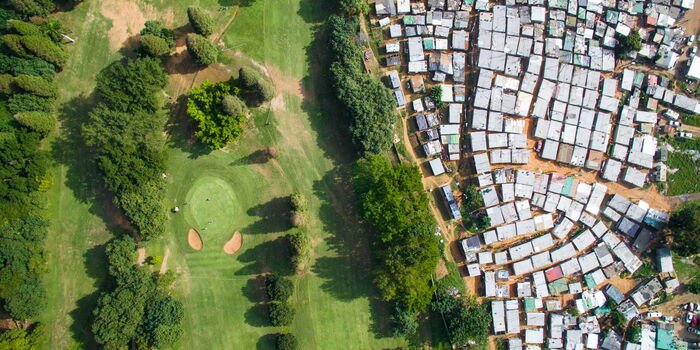
Oduor said the lack of greenery reflects a wider pattern of unequal environmental conditions across Nairobi. The contrast is clear when Mathare is compared with nearby affluent areas such as Muthaiga. Aerial views show dense tree cover in wealthier neighbourhoods, while informal settlements remain largely bare.
Oduor describes this divide as environmental segregation, where access to green space closely follows income and class lines. Similar patterns exist elsewhere in the city, including between Karen and Kibera, and Lavington and Kawangware.
Journalist and writer Oyunga Pala links these inequalities to Nairobi’s colonial planning. Between 1906 and 1926, most residential land was allocated to European settlers, while African communities were confined to overcrowded areas with little infrastructure.
After independence in 1963, these spatial divisions remained largely unchanged, with elite groups taking over former colonial neighbourhoods. Today, around 70 percent of Nairobi’s four million residents live on about five per cent of the city’s land. Informal settlements continue to grow as people migrate in search of work, often settling in areas with limited services and few public amenities.
Public green spaces reflect this imbalance. Well-maintained parks and forests, including City Park, Karura Forest and the Arboretum, are located near wealthier districts. Low-income areas in the eastern parts of the city have few public spaces, and those that exist often lack vegetation.
Against this backdrop, the Mathare Green Movement frames tree planting as both an environmental intervention and a claim to equal treatment.


Comments
No comments yet — be the first.