
Only 2% of Kenyans Drive to Work, 73% Walk
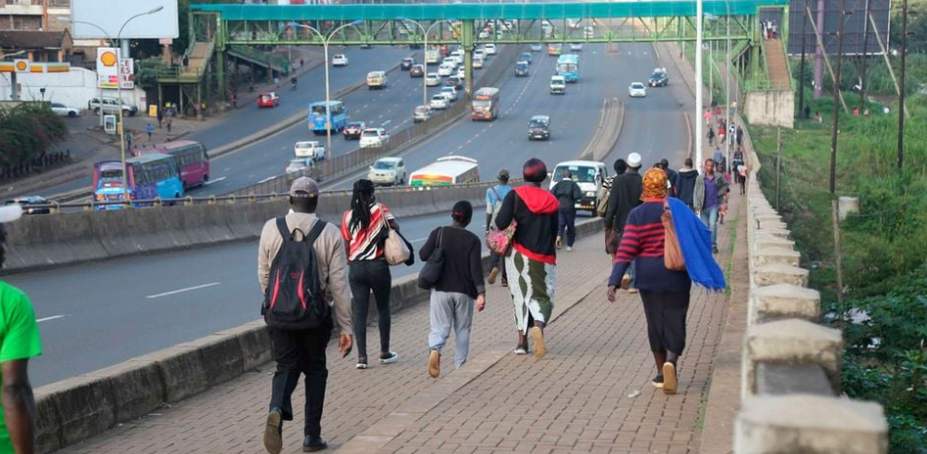
A recent report has revealed that a mere two percent of the workforce relies on private cars for travel to work.
In urban areas, six percent of workers opt for private vehicles, compared to just 1.4 percent in rural regions. According to the Kenya Housing Survey, the transportation modes reveal a stark division between urban and rural settings. While urban regions exhibit a slightly greater reliance on private automobiles, the predominant methods of commuting for most Kenyans remain walking and the use of public transport, including boda bodas (motorcycle taxis).
As of 2023, approximately 21 million Kenyans were actively participating in the labour force, encompassing both formal wage employees and those engaged in informal subsistence activities like farming. Among this workforce, only two percent commute by car. The Economic Survey 2024 further delineates the labour force, recording 3.1 million wage employees alongside 16.7 million individuals working in the informal sector.
Walking is the primary mode of transportation, with an overwhelming 72.7 percent of the population walking to work. This figure is markedly higher in rural areas, where 82.5 percent walk, compared to 53.4 percent in urban settings. These statistics suggest that many Kenyans either reside close to their jobs or lack the financial resources to support regular transportation costs. The reliance on public transport is reflected in the 12.2 percent of the population utilizing services such as matatus (shared minibuses), PSVs, and buses.
“Walking was the predominant mode of transport to work, with 72.7 percent of Kenyans walking to work, with rural areas recording the highest percentage (82.5 percent) compared to urban areas (53.4 percent),” the report notes.
This figure contrasts sharply with rural usage, where only 4.9 percent use public transport, compared to 26.7 percent in urban areas. Boda bodas are well-favoured across the country, with usage rates of 10.4 percent in rural settings and 10.9 percent in urban locations. Alternative modes of transportation, such as tuktuks, taxis, and water vessels, maintain a minimal presence in commuting patterns. Specifically, tuktuks are used by 0.7 percent of the workforce, taxis by 0.2 percent, and water vessels or school buses by 0.1 percent.
“Public transport (matatu/PSV/bus) was more common in urban areas (26.7 percent) compared to rural areas (4.9 percent). The use of boda bodas (bicycles and motorbikes) was popular in both rural and urban areas at 10.4 percent and 10.9 percent, respectively,” the report states.






Comments
No comments yet — be the first.