


Shakahola: Bereaved Families Demand Justice Beyond Mackenzie's 200-Year Sentence

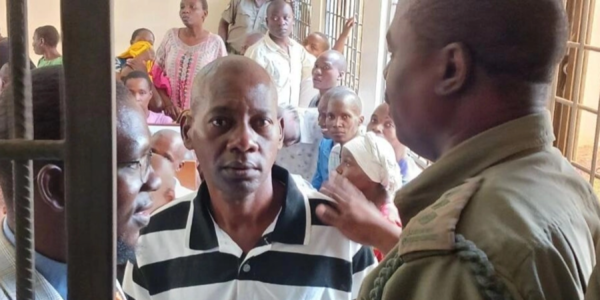
Interior Cabinet Secretary Kipchumba Murkomen has announced plans to place controversial preacher Paul Nthenge Mackenzie in total isolation in prison, even as victims' families demand that state officers who turned a blind eye to the Shakahola tragedy be held accountable.
Speaking during a church service in Ikolomani Constituency, Kakamega on Sunday, Murkomen revealed that the government will provide a secluded area to hold Mackenzie to prevent him from radicalizing other inmates and prison warders.
"We will provide a secluded area to hold him to make sure that there will be no radicalisation again by the type of Mackenzies in this country," Murkomen said, citing intelligence reports that the preacher had already tried to influence fellow prisoners and police officers while in custody.
The government's security move comes days after High Court Judge Diana Rachel Kavedza-Mochache delivered a landmark judgment at the Mombasa High Court on November 6, 2026. She sentenced Mackenzie to 200 years in prison after finding him guilty of murdering 191 people, including 190 children, at his Good News International Ministries in Shakahola, Kilifi County.
The court handed Mackenzie consecutive 100-year prison terms for 183 counts of murder by starvation and eight counts of direct homicide committed between January 2021 and September 2023. Twenty-eight of his co-accused were also convicted, receiving sentences ranging from 10 to 160 years.
However, relatives of the victims say the 200-year sentence fails to address the wider institutional failures that allowed hundreds of people to die in the forest.
Roseline Asena, who lost her brother, sister-in-law and five nieces and nephews, questioned why local security officials faced no consequences for failing to act while lives were being lost.
“The sentence is okay but it has only addressed criminality and not institutional justice...kuna maafisa waliona watu wakifa wakinyimwa chakula..kulikuwa na ocs kulikuwa na OCPD walikuwa wapi haya yakiendelea,” Asena told Citizen TV.
Asena added that the sentence does little to ease her pain, calling for an investigation into public officers who watched the events unfold.
“Tunaamini mahakama imeefanya hatua ya kwanza tuanze mjadala wa hatua ya pili. Tuangalie waliosimama wakaangalia kile kilikuwa kinatendeka watachukuliwa hatua gani,” she said.
For many families, the trauma is compounded by their inability to obtain the remains of their relatives for burial. Asena noted that watching news of Mackenzie remains deeply painful, wishing families had clear official channels to get answers.
Another victim, Michael Ruwa, who lost seven family members, expressed dissatisfaction with the length of the sentence, arguing that Mackenzie should have faced execution.
“Kivyangu angehukumiwa kinyonga. Haki za watoto haijapatikana kikamilifu,” Ruwa said.
Ruwa and other affected families are now demanding compensation from the government, insisting that Mackenzie's church assets and land be liquidated to pay the victims' relatives.
“Kuna kanisa kuna mashamba ya mackenzie ambayo serikali ingeuza na kupewa sisi tuliofiwa,” Ruwa added.
During the sentencing, prosecutors had requested the death penalty, but Justice Kavedza-Mochache rejected the prayer.
The judge reasoned that executing Mackenzie could be viewed by his followers as martyrdom rather than punishment, given their belief that death was a pathway to heaven. She also emphasized the importance of keeping convicted persons alive in case they can provide details about missing victims and the location of their remains.
Justice Kavedza-Mochache, whose judicial career began in 1993 as a District Magistrate II (Professional), brought extensive experience in criminal justice and counter-terrorism to the high-profile case.
She holds a Bachelor of Laws and Master of Laws from the University of Nairobi, a postgraduate diploma from the Kenya School of Law, and completed strategic leadership training in Kenya and the United States.
Before her elevation to the High Court in 2022, she served as the pioneer head of station at both the Shanzu Counter-Terrorism Court in Mombasa and the Kahawa Counter-Terrorism Court in Nairobi. In those roles, she presided over complex cases, including the prosecution of two men convicted and sentenced to 30 years in prison for facilitating the January 2019 DusitD2 terrorist attack.
Despite praising the Judiciary, the Directorate of Criminal Investigations (DCI) and the Office of the Director of Public Prosecutions (ODPP) for securing the convictions, CS Murkomen acknowledged that the state must act firmly against religious extremism while safeguarding freedom of worship.

Comments
No comments yet — be the first.